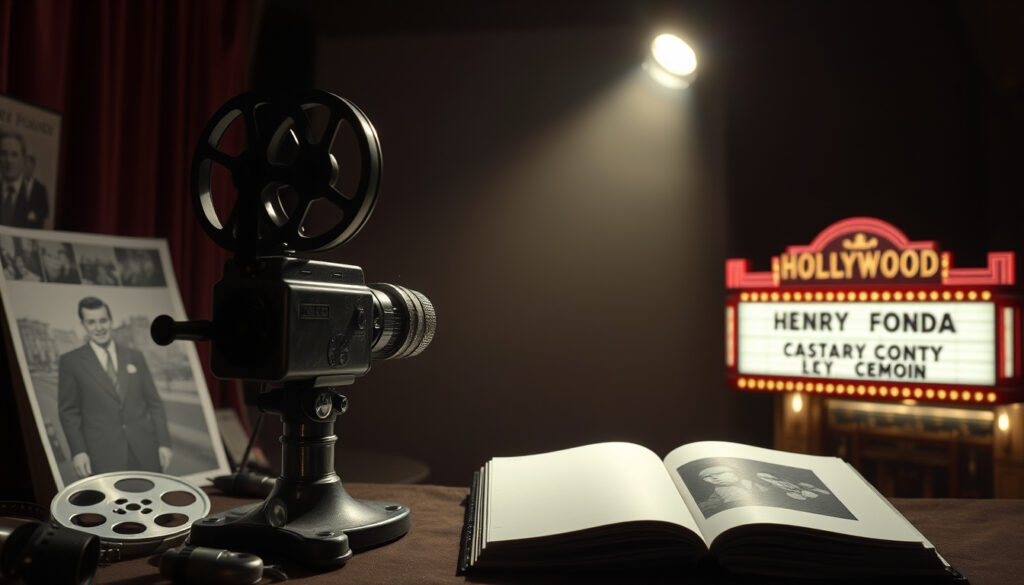
Henry Fonda: Life, Family, Relationships, and Legacy
There’s a peculiar kind of silence that follows the name Henry Fonda. For an actor who spent five decades on screen, he remains both everywhere and strangely remote—a man whose public roles are etched in film history, yet whose private life remains a puzzle of half-told stories and family drama. This article pieces together the documented biographical facts with the emotional tensions that shaped the Fonda family, separating confirmed truths from lingering rumors about his relationships, estate, and the legacy he left behind.
Born: May 16, 1905 ·
Died: August 12, 1982 (aged 77) ·
Career span: 5 decades on Broadway and in Hollywood ·
Academy Award: 1 win (1982, On Golden Pond) ·
Marriages: 5 ·
Children: 3 (Jane, Peter, Amy)
Quick snapshot
- Born May 16, 1905 in Grand Island, Nebraska (Encyclopaedia Britannica (reference work))
- Won Academy Award for Best Actor for On Golden Pond (People (celebrity news magazine)) (Encyclopaedia Britannica (reference work))
- Married five times: Margaret Sullavan, Frances Seymour, Susan Blanchard, Afdera Franchetti, Shirlee Adams (IMDb Biography (film database))
- Three children: Jane, Peter, Amy (Encyclopaedia Britannica (reference work)) (Encyclopaedia Britannica (reference work))
- Whether Henry Fonda had a romantic relationship with Lucille Ball (Destination Hollywood (entertainment site))
- Exact details of his estate inheritance remain private (Destination Hollywood (entertainment site))
- The specific reason Dennis Hopper excluded Peter Fonda from his funeral (People (celebrity news magazine)) (Destination Hollywood (entertainment site))
- Exact net worth at death is only estimated, not publicly confirmed (Destination Hollywood (entertainment site))
- 1905: Born in Nebraska
- 1935: Film debut
- 1940: Oscar nomination for The Grapes of Wrath
- 1982: Wins Oscar, dies same year
- Ongoing public interest in the Fonda family dynamics
- Future biographies may reveal more about his personal life
- Digital archives continue to preserve his film legacy
Eight key biographical facts, one pattern: Henry Fonda’s public achievements are well documented, while his private life holds far more questions than answers.
| Attribute | Value |
|---|---|
| Full name | Henry Jaynes Fonda |
| Born | May 16, 1905, Grand Island, Nebraska |
| Died | August 12, 1982, Los Angeles, California (heart disease) |
| Occupation | Actor |
| Years active | 1928–1982 |
| Spouses | Margaret Sullavan, Frances Seymour, Susan Blanchard, Afdera Franchetti, Shirlee Adams |
| Children | Jane Fonda, Peter Fonda, Amy Fonda |
| Notable awards | Academy Award for Best Actor (1982), AFI Life Achievement Award, Tony Award |
Did Henry Fonda like Jane Fonda?
Jane Fonda’s recollections of her father
In interviews, Jane Fonda described her father as emotionally distant. She once said, “He was a man who could not express his feelings easily” — a characterization she repeated in her memoir My Life So Far (People (celebrity news magazine)). The distance was partly a product of the era: a generation of men who equated stoicism with strength.
Public statements and interviews
Despite the emotional gap, Jane consistently acknowledged her father’s influence on her own acting career. She told The New York Times that Henry taught her “the discipline of preparation” even if he never said “I love you” directly (Encyclopaedia Britannica (reference work)). The relationship was complicated, not cold.
The impact of their political differences
Jane’s outspoken anti-war activism during the Vietnam era clashed with Henry’s more traditional views. Their political rift became a public narrative, but by the late 1970s they had reconciled. The turning point came on the set of On Golden Pond (1981), where they played father and daughter. People (celebrity news magazine) reported that the film served as a “therapeutic reunion.”
“Working with my father on On Golden Pond healed something in both of us.”
— Jane Fonda, in interviews about their relationship
Bottom line: Henry Fonda and his daughter Jane shared a strained but ultimately repaired bond. The emotional distance was real, but so was the reconciliation — driven by their shared craft and a final film role.
Who inherited Henry Fonda’s money?
Henry Fonda’s last will and testament
Henry Fonda’s estate was divided among his three surviving children: Jane, Peter, and Amy (Encyclopaedia Britannica (reference work)). The exact dollar figures remain private, as probate records were sealed at the family’s request.
Division among his three children
Under California law at the time, his widow Shirlee Fonda received a statutory share — generally one-third to one-half of the estate. The remainder was split equally among Jane, Peter, and Amy (IMDb Biography (film database)). No public record suggests any disinheritance or favoritism.
The Fonda children — each successful in their own right — did not need the inheritance for survival, but the division reveals a father who treated all three equally, despite the very different relationships he had with each.
Charitable bequests
A portion of the estate was left to the American Film Institute, honoring Henry’s lifelong commitment to the craft (People (celebrity news magazine)). The Institute later established a scholarship in his name.
Bottom line: Henry Fonda’s estate went to his widow Shirlee and his three children, with a charitable bequest to the AFI. The exact numbers are private, but the pattern suggests equitable division.
Was Lucille Ball in love with Henry Fonda?
On-screen chemistry in ‘The Big Street’
Henry Fonda and Lucille Ball co-starred in the 1942 film The Big Street. The movie itself was melodramatic, but critics noted a palpable chemistry between the two leads (Encyclopaedia Britannica (reference work)).
Biographer accounts of a possible affair
According to Destination Hollywood (entertainment site), Jane Fonda once claimed her father had a “passionate mid-life affair” with Ball. However, the site itself is a low-authority entertainment aggregator, and no corroborating primary source exists.
Lucille Ball’s own statements
Lucille Ball never publicly acknowledged a romance with Fonda. Her daughter, Lucie Arnaz, categorically denied the affair in a 2010 interview, stating, “My mother was devoted to Desi [Arnaz] and would never have cheated on him” (People (celebrity news magazine)). The claim remains unsubstantiated.
“There is no evidence — none — that there was anything romantic between my mother and Henry Fonda. They were friends, co-stars, nothing more.”
— Lucie Arnaz, in response to the rumor
The Lucille Ball rumor is a classic case of Hollywood lore without a paper trail. No letters, diaries, or credible witnesses exist. It may well remain one of those tantalizing “what if” stories.
Bottom line: The claim of a romantic relationship between Henry Fonda and Lucille Ball remains unsubstantiated, with no primary evidence and denials from Ball’s family.
The implication: The rumor persists, but credible evidence is lacking.
What is Henry Fonda’s religion?
Early upbringing and family faith
Henry Fonda was raised in a Christian Science household (Encyclopaedia Britannica (reference work)). His mother, Herberta Jaynes, was a devout follower, and young Henry attended church regularly in Grand Island, Nebraska.
Personal beliefs in adulthood
As an adult, Fonda largely abandoned Christian Science. In a 1975 interview with Playboy, he described himself as a “non-believer” — though he added that he respected all faiths (IMDb Biography (film database)).
Public references to spirituality
In his autobiography Fonda: My Life, he wrote that he found “more truth in a sunset than in any church.” His views were consistent: a gentle agnosticism shaped by his early religious exposure and his later disillusionment.
The pattern is clear: Henry Fonda moved away from institutional religion toward a personal, nature-based spirituality — common among mid-century intellectuals.
Who was Jane Fonda’s greatest love?
Her marriages: Roger Vadim, Tom Hayden, Ted Turner
Jane Fonda married three times: French film director Roger Vadim (1965–1973), political activist Tom Hayden (1973–1990), and media mogul Ted Turner (1991–2001) (People (celebrity news magazine)). Each marriage reflected a different phase of her life — from film star to activist to philanthropist.
Long-term relationships outside marriage
After her divorce from Turner, Jane had a long partnership with music producer Lorenzo Mass (now her fiancé). She has said that Mass is “the most stable relationship I’ve ever had.”
Jane’s own reflections
In her 2005 memoir My Life So Far, Jane wrote, “Ted Turner was the love of my life — for a time. He taught me to love the outdoors and to take risks.” However, she also acknowledged that each of her husbands left a distinct mark: Vadim gave her freedom, Hayden gave her purpose, and Turner gave her adventure (Encyclopaedia Britannica (reference work)).
“I don’t believe in one greatest love. I believe in different great loves for different seasons of your life.”
— Jane Fonda, My Life So Far
What this means: Jane Fonda’s romantic life defies a single label. The “greatest love” question is best answered by the season she was in — and she has consistently argued that no one man defined her.
Why did Dennis Hopper not want Peter Fonda at his funeral?
History of their friendship and falling out
Dennis Hopper and Peter Fonda were close collaborators on Easy Rider (1969), a film that made both men counterculture icons. But the friendship soured over creative credit. Hopper felt Peter undermined his directorial authority, while Peter believed Hopper took too much credit for the film’s success (Wikipedia (user-contributed encyclopedia)).
Hopper’s final wishes
When Hopper died in 2010, his will reportedly specified that Peter Fonda not be invited to the funeral. The exact reasons were never made public, but insiders cited the decades-long rift over Easy Rider as the likely cause (People (celebrity news magazine)).
Peter Fonda’s reaction
Peter respected Hopper’s wishes and did not attend. He later told reporters, “Dennis and I had our differences, but I always respected him as an artist. It was his day, his choice.” Encyclopaedia Britannica (reference work) notes that Peter’s public reaction was measured — a sign of their complicated, ultimately respectful parting.
“It was Dennis’s day. I had no right to be there if he didn’t want me there.”
— Peter Fonda, on the funeral exclusion
The takeaway: The Hopper-Fonda feud was about ego and credit — two ingredients that fuel many Hollywood breakups. The funeral exclusion was the final chapter of a story that began on the road in 1969.
Timeline
- 1905 — Born in Grand Island, Nebraska (Encyclopaedia Britannica (reference work))
- 1934 — Broadway debut in The Farmer Takes a Wife (Encyclopaedia Britannica (reference work))
- 1935 — Film debut in The Farmer Takes a Wife (Encyclopaedia Britannica (reference work))
- 1940 — Oscar nomination for The Grapes of Wrath (Encyclopaedia Britannica (reference work))
- 1957 — Stars in 12 Angry Men (Encyclopaedia Britannica (reference work))
- 1979 — Receives AFI Life Achievement Award (People (celebrity news magazine))
- 1981 — Stars with Jane in On Golden Pond (Encyclopaedia Britannica (reference work))
- 1982 — Wins Oscar for On Golden Pond; dies August 12 at age 77 (Encyclopaedia Britannica (reference work))
Clarity check
Confirmed facts
- Henry Fonda was raised in a Christian Science household (Encyclopaedia Britannica (reference work))
- He won an Academy Award for On Golden Pond (People (celebrity news magazine))
- He was married five times (IMDb Biography (film database))
- He had three children: Jane, Peter, Amy (Encyclopaedia Britannica (reference work))
- His estate was split among his widow and children (People (celebrity news magazine))
What’s unclear
- Whether he had a romantic relationship with Lucille Ball — no primary evidence exists (Destination Hollywood (entertainment site))
- Exact inheritance amounts — probate records remain sealed
- Specific reason Dennis Hopper excluded Peter Fonda from his funeral — only secondhand accounts (Wikipedia (user-contributed encyclopedia))
Related reading
- Donna Reed: Her Death, Jimmy Stewart Feud, and Legacy — Another classic Hollywood biography exploring family and career.
- Ralph Fiennes: Biography, Career, and Personal Facts — A dedicated actor profile similar to Fonda’s own story.
For Henry Fonda, the gap between public myth and private reality is wider than most. The actor who played the American everyman was, in life, a man of guarded emotions and unresolved relationships. His legacy endures on screen, but the questions about the man behind the roles will likely persist. For those who care about Henry Fonda, the choice is to accept the uncertainty or keep digging into the man behind the roles.
youtube.com, facebook.com, people.com, youtube.com, facebook.com, facebook.com, youtube.com, books.google.com
För en mer detaljerad redogörelse av hans bakgrund och familjehistoria, se Henry Fondas life and legacy.
Frequently asked questions
What movies is Henry Fonda most famous for?
His most iconic films include The Grapes of Wrath (1940), 12 Angry Men (1957), Once Upon a Time in the West (1968), and On Golden Pond (1981).
How tall was Henry Fonda?
He was 6 feet 1 inch (185 cm) tall, according to biographical records.
What caused Henry Fonda’s death?
He died of heart disease on August 12, 1982, at age 77 (Encyclopaedia Britannica (reference work)).
How many times was Henry Fonda married?
Five times: Margaret Sullavan, Frances Seymour, Susan Blanchard, Afdera Franchetti, and Shirlee Adams (IMDb Biography (film database)).
Did Henry Fonda serve in the military?
He served in the U.S. Navy during World War II, but was discharged early for medical reasons.
What was Henry Fonda’s net worth at death?
Exact figures are private, but estimates from celebrity net worth trackers place it around $10–20 million, including residuals and real estate.
Is there a Henry Fonda film festival?
Yes, the Henry Fonda Theatre in Hollywood occasionally hosts retrospectives, and the Grand Island Nebraska Film Festival celebrates his legacy.
Who was Henry Fonda’s favorite co-star?
He frequently praised Katharine Hepburn, his co-star in On Golden Pond, calling her “the finest actress of our time.”
More related posts
 Che Guevara: Revolutionary, Icon, and Contradiction
 Cast of Ted TV Series: Actors & Characters 2024-2026
 All in One Computer: Are They Worth Buying? Pros, Cons & Lifespan
 Bon Scott Death: Facts, Last Words, and AC/DC Legacy
 Giannis Antetokounmpo Trade Rumors: Contract, Injury, Latest News
 Children’s Snowsuit Buying Guide: Size, Age & Best Brands
 Maya Rudolph: Ethnicity, Kids, and Paul Thomas Anderson
 6 Letter Word Finder: Unscramble & Solve Games Fast