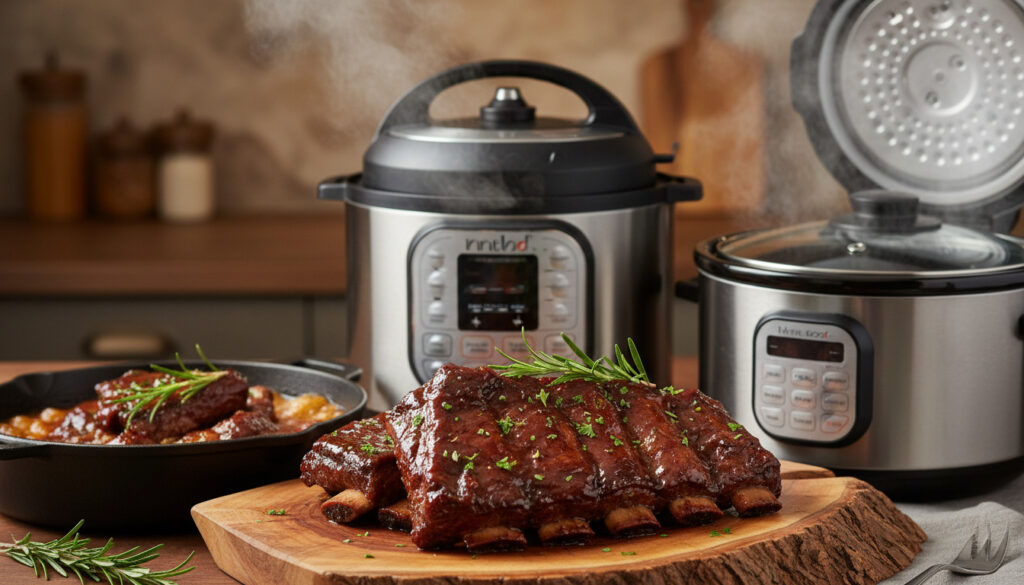
Beef Short Ribs Recipe – Oven, Slow Cooker, Instant Pot
Beef short ribs deliver intense, rich flavor when cooked properly, transforming from a tough, collagen-heavy cut into fork-tender meat with a silky texture. The key lies in patience and method, as these ribs demand low temperatures and extended time to break down connective tissue into gelatin.
Home cooks face multiple decisions when approaching this cut: oven braising, pressure cooking, slow cooking, or smoking. Each technique yields distinct textures and flavor profiles, from the concentrated jus of a Dutch oven braise to the efficiency of an Instant Pot.
This guide examines the science behind tender short ribs, compares cooking durations across methods, and provides specific preparation techniques verified by tested recipes.
What Is the Best Way to Cook Beef Short Ribs?
The optimal approach depends on available time and equipment, though all methods share a common requirement: sustained low heat to render fat and dissolve collagen into gelatin. Oven braising remains the gold standard for depth of flavor, while pressure cooking offers speed without sacrificing tenderness.
| Method | Time | Difficulty | Best For |
|---|---|---|---|
| Oven Braise | 3-4 hrs | Medium | Deep Flavor |
| Slow Cooker | 6-8 hrs | Easy | Hands-off |
| Smoker | 5-6 hrs | Medium | BBQ |
| Instant Pot | 1-1.5 hrs | Easy | Speed |
Several constants apply across all techniques. The following principles ensure consistent results:
- Low-and-slow cooking breaks down collagen into unctuous gelatin
- Searing before braising creates the Maillard reaction for deeper flavor
- Internal temperatures must reach 160-205°F for complete collagen conversion
- Flanken-cut ribs cook faster than English-cut due to increased surface area
- Resting meat after cooking prevents moisture loss during serving
- Skimming rendered fat from the sauce improves final texture
- Deglazing the pan captures fond for complex sauce bases
| Fact | Detail |
|---|---|
| Cut Origin | Plate or chuck primal |
| Fat Content | High marbling |
| Calories (4oz serving) | 300-400 (post-trimming) |
| Protein | 18g per serving |
| Key Nutrient | Collagen (converts to gelatin) |
| Ideal Internal Temp | 160-205°F |
| Best Liquid Level (Oven) | 2/3 up the ribs |
How Long Do Beef Short Ribs Take to Cook?
Duration varies significantly by method and temperature, with oven braising offering the most flexibility for scheduling.
Oven Temperatures and Timing
Dutch oven braising accommodates multiple temperature points depending on scheduling constraints. At 300°F, ribs require approximately 3 hours. Increasing to 325°F extends the window to 3-4 hours, while 350°F reduces cooking time to 2-2.5 hours. Covering the pot ensures moisture retention during the long cook.
Pressure Cooking Durations
The Instant Pot dramatically reduces active cooking time. High pressure settings require 25-60 minutes depending on thickness, followed by a 10-15 minute natural release. Forty-five minutes under pressure plus natural release yields fall-off-the-bone results for English-cut ribs. Flanken-cut BBQ styles may finish in as little as 25 minutes.
Slow Cooker Windows
Slow cookers offer the most forgiving timing. Low settings require 8-10 hours, while high settings complete in 4-5 hours or 7-8 hours depending on quantity. Pre-searing ribs and sautéing vegetables before transferring to the cooker maximizes flavor development.
Oven braising works across a 50-degree range (300-350°F) with corresponding time adjustments, making it easier to align with meal schedules than strict-pressure methods.
How to Make Beef Short Ribs Tender
Tenderness results from proper breakdown of connective tissue combined with moisture retention techniques.
The Science of Collagen
Beef short ribs contain abundant collagen, a protein that tightens under high heat but dissolves into silky gelatin when held at low temperatures (160-205°F) over extended periods. This gelatin provides the characteristic mouthfeel of properly cooked ribs.
Preparation and Trimming
Pat ribs completely dry before seasoning generously with salt and pepper. Trim excess external fat cap only if desired to reduce grease, leaving some fat intact for moisture and flavor. Focus on removing tough sinew rather than attempting membrane removal, as beef short ribs lack the prominent silver skin found on pork ribs.
Searing Technique
Sear ribs in batches using 2-3 tablespoons of oil or bacon fat over high heat to develop a golden crust without overcrowding. Deglaze the pan with beer, wine, or broth to capture browned bits. This fond forms the foundation of complex braising liquids.
Alternative Cooking Methods for Beef Short Ribs
Beyond standard oven braising, several specialty methods produce distinct results.
Smoked Short Ribs
Smoking at 225-250°F for 5-8 hours until reaching approximately 203°F internal temperature creates a bark exterior with pull-apart texture. Use BBQ rubs and wood smoke for flavor. Wrapping in foil partway through helps retain moisture during extended smokes.
Asian-Style Variations
Korean galbi and similar preparations use flanken-cut ribs (½-inch thick cross sections) marinated in soy, brown sugar, ginger, sesame, and chili. These cook faster than English-cut and work across all methods: 45 minutes in the Instant Pot, 4-5 hours on high in a slow cooker, or 3-4 hours at 325°F in the oven.
Unlike pork ribs, beef short ribs do not require membrane removal. The cut lacks the thick silver skin layer that characterizes pork spare ribs; instead, focus knife work on visible sinew and external fat caps only.
Oven braising requires liquid to submerge ribs two-thirds of the way, while Instant Pot methods need only 1-2 cups total. Excess liquid in pressure cookers dilutes sauces and prevents proper concentration.
What Is the Step-by-Step Cooking Process?
- Prep: Trim excess fat, pat dry, season generously with salt and pepper
- Sear: Brown ribs in batches using hot oil or bacon fat without crowding
- Deglaze: Add beer, wine, or broth to capture fond from pan bottom
- Build: Add vegetables, herbs, and liquid to appropriate level for method
- Cook: Braise at low heat until probe-tender (meat falls from bone)
- Rest: Allow 10-15 minutes rest post-cooking to stabilize juices
- Finish: Skim fat from sauce, thicken if desired, and serve
What Is Established vs. Variable About Short Rib Cooking?
| Established Facts | Variable Factors |
|---|---|
| Braising tenderizes via collagen breakdown at 160-205°F internal temperature | Exact minutes per pound due to bone-in vs. boneless variations |
| Searing improves flavor via Maillard reaction before moist cooking | Specific calorie counts (300-400 per 4oz) vary by trim level and sauce |
| Short ribs originate from plate or chuck primal cuts | Optimal resting time beyond standard 10-15 minutes remains untested |
| Pressure cooking requires significantly less liquid than oven methods | Individual oven hot spots may affect cooking uniformity |
What Are Beef Short Ribs?
Beef short ribs come from the plate or chuck primal sections of the cow, located in the lower chest and shoulder areas. This cut contains significant intramuscular fat and connective tissue, making it flavorful but tough without proper preparation. Butchers typically offer two cuts: English-cut (individual ribs with thick meat layers) and flanken-cut (thin cross-sections across multiple ribs).
The high collagen content that makes short ribs tough also makes them ideal for braising. When held at low temperatures for extended periods, this collagen converts to gelatin, creating the rich, unctuous texture characteristic of well-prepared short ribs.
What Do Experts Recommend?
“For beer-braised short ribs, rendering bacon first provides a fat base for searing the meat, while the beer deglazes the pot and adds malty depth to the final sauce. The ribs should return to the blended sauce after cooking to absorb flavor.”
— Natalie Marble Cooks
“Instant Pot short ribs require dredging in flour before browning to help thicken the gravy naturally. The pressure environment concentrates flavors faster than traditional methods, though you may need to reduce the sauce separately after cooking.”
— Tastes Better From Scratch
Which Method Should You Choose?
Select oven braising when maximum flavor development and sauce concentration matter most, particularly for wine or beer-based preparations. Choose the Instant Pot for weeknight dinners requiring speed without sacrificing tenderness. Opt for smoking when seeking BBQ bark and wood-smoke flavor. For a versatile recipe tested across multiple methods, see Beer Braised Beef Short Ribs (Oven, Instant Pot, Slow Cooker) or try the Instant Pot Short Ribs for pressure-cooked efficiency.
Frequently Asked Questions
Are beef short ribs tough?
Raw beef short ribs are tough due to high collagen content. They require low-and-slow cooking to break down connective tissue into tender gelatin.
What temperature should beef short ribs reach?
Cook to an internal temperature between 160-205°F. Collagen breakdown accelerates above 160°F, while 203-205°F typically yields probe-tender, fall-off-the-bone texture.
Can you cook beef short ribs in a slow cooker?
Yes. Cook on low for 8-10 hours or high for 4-5 hours. Pre-searing the ribs and vegetables before transferring to the slow cooker improves flavor.
Do you remove the membrane from beef short ribs?
No. Unlike pork ribs, beef short ribs lack a prominent silver skin membrane. Remove only tough external sinew and excess fat caps.
How do you store leftover short ribs?
Refrigerate in cooking liquid for 3-4 days. The gelatin-rich sauce solidifies when cold but reliquifies when reheated gently.
What is the difference between English cut and flanken cut?
English cut features thick sections cut between the bones. Flanken cut slices across multiple bones creating thin strips ideal for Korean BBQ and faster cooking.
More related posts
 Panoramic Sunroof Repair Cost – 2025 Averages and Fixes
 Niagara-on-the-Lake Travel Guide: Things to Do, Wineries & More
 What is a Preposition? Definition, Examples, and How to Use Them
 Knox Jolie-Pitt – Age, Family and 2024 Updates
 When Do Babies Start Teething? Signs, Age & Timeline
 170 C to F: Exact Conversion and Oven Settings
 Karen Gillan Biography: Age, Husband, Movies & Facts (2024)
 Wiarton Willie Dies 2026: Life, Predictions, Legacy