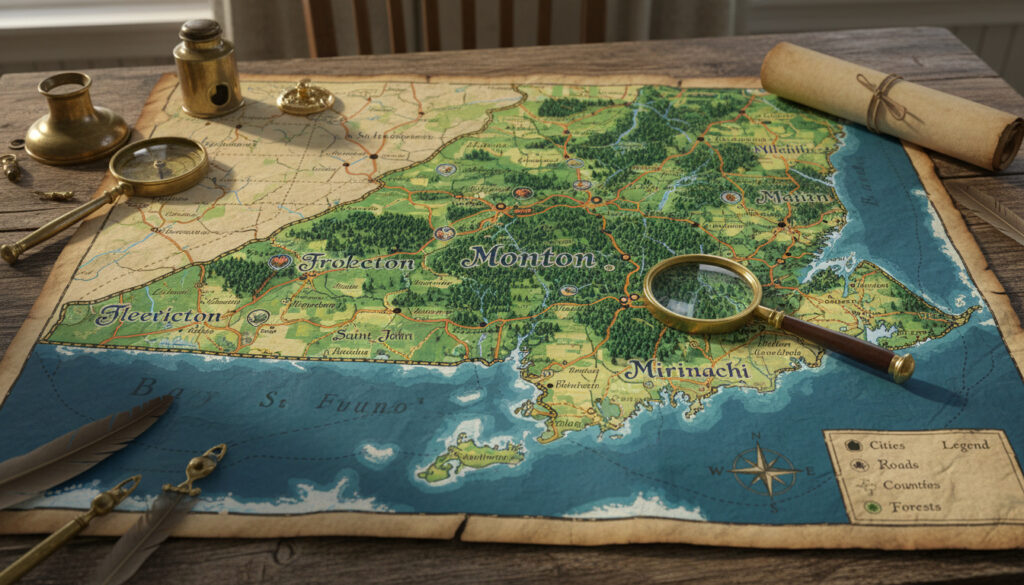
Map of New Brunswick – Detailed Guide to Cities, Roads, Counties
New Brunswick occupies a strategic position as a Maritime province on Canada’s eastern seaboard, bordered by Quebec to the north, Nova Scotia to the southeast, Prince Edward Island across the Northumberland Strait, and the U.S. state of Maine to the west. The province’s geography is defined by its position between the Gulf of St. Lawrence to the northeast and the Bay of Fundy to the southwest, creating a complex cartographic landscape that balances coastal boundaries with interior terrain.
The province spans 72,908 square kilometres, making it the third-smallest in Canada by land area yet the eighth-most populous. Its topography transitions from the rugged Appalachian Mountains in the west, where elevations reach 1,412 metres, to flatter eastern coastal plains that dip to three metres below sea level. Approximately 85% of the territory remains forested, a feature that dominates satellite imagery and topographic representations.
Accurate mapping of New Brunswick requires attention to its unique administrative history, bilingual status, and hydrological systems. The province maintains Canada’s only official bilingual designation, with English and French place names appearing on all government charts, while the Saint John and Miramichi river systems create natural boundaries that influence both transportation routes and municipal divisions.
Where Is New Brunswick Located?
- New Brunswick represents the only Canadian province sharing a land border with Maine, USA.
- The Bay of Fundy defines the southwestern coastline, featuring the world’s highest tidal range.
- The Northumberland Strait creates a maritime boundary with Prince Edward Island to the east.
- Forested terrain covers 85% of the provincial landmass, visible on all physical maps.
- The province functions as a terrestrial link between Nova Scotia and continental Canada.
- Elevation varies dramatically from -3 metres at coastal areas to 1,412 metres in the Appalachians.
- Bilingual mapping conventions apply province-wide, reflecting official English and French status.
| Geographic Fact | Verified Detail |
|---|---|
| Total Area | 72,908 sq. km (28,150 sq. miles) |
| Provincial Size Rank | Third-smallest in Canada |
| Northern Boundary | Quebec |
| Western Boundary | State of Maine, USA |
| Southeastern Boundary | Nova Scotia |
| Eastern Maritime Border | Prince Edward Island (via Northumberland Strait) |
| Northeastern Coastline | Gulf of St. Lawrence |
| Southwestern Coastline | Bay of Fundy |
| Maximum Elevation | 1,412 metres |
| Minimum Elevation | -3 metres (coastal) |
| Mean Elevation | 152–165 metres |
| Forest Coverage | 85% of total area |
What Are the Major Cities and Counties in New Brunswick?
Key Cities Marked on the Map
Fredericton serves as the provincial capital, positioned along the Saint John River in the west-central region. Despite its administrative prominence as the cultural, educational, and commercial center, it ranks as the province’s third-largest city by population. World Atlas identifies the city’s specific coordinates along the river valley.
Moncton dominates as the most populous urban center, situated in the Petitcodiac River valley at the geographic heart of the Maritime provinces. Known regionally as the “Hub City,” it functions as the primary transportation nexus for the region. The province recognizes eight cities total within its 104 municipalities, which include 61 villages, 26 towns, and eight rural communities.
County Boundaries
Historical maps display 15 counties established during the colonial period, though these boundaries hold no current administrative authority. The provincial government abolished counties and parishes in 1966, replacing them with 236 Local Service Districts and 12 Regional Service Commissions. Statistics Canada continues to use the historical county designations for census enumeration and data collection purposes, while residents maintain them for cultural identity.
The 15 counties visible on historical maps were officially abolished in 1966. Current governance uses 104 municipalities including eight cities, 61 villages, 26 towns, and eight rural communities. Regional Service Commissions now handle planning and coordination.
How to Access Interactive and Road Maps of New Brunswick?
Interactive Tools and Embeds
The Government of New Brunswick maintains an official transportation portal providing digital cartography for public use. Provincial authorities publish county and districts maps showing transportation districts, highways, and natural features alongside municipal boundaries.
The Atlas of New Brunswick—Digital Edition, accessible through the federal geospatial platform, contains over 2,000 maps at 1:30,000 and 1:150,000 scales. The digital atlas provides comprehensive GIS boundaries for researchers and planners. Free topographic visualization tools display elevation data with coordinates spanning 44.28367° to 48.22068° North and -69.05347° to -63.32887° West, as documented by topographic mapping services.
Road and Highway Details
Designated Highways Mapbooks offer detailed views of municipalities, communities, and road networks for navigation and logistics planning. The 2025 Municipal Kilometrage Reports list all streets within localities alongside their lengths, updated annually though unofficial for legal surveys. Traffic counter data and wildlife mitigation maps showing crossing locations and fencing supplement standard road charts.
Satellite and elevation imagery from GIS Geography highlights highways, rivers, lakes, and cities against the backdrop of the Appalachian Mountains and Bay of Fundy. A static road map displaying counties and towns is available through Wikimedia Commons under open license.
How Big Is New Brunswick and What Is Its Scale?
Area, Dimensions, and Map Scale
The province encompasses 72,908 square kilometres of diverse terrain, stretching from the Appalachian highlands to the coastal lowlands. Cartographic representation varies by application: detailed municipal planning requires 1:30,000 scale precision, while regional highway navigation utilizes 1:150,000 scale charts. Geological surveys confirm the province’s dimensions and topographic variations.
Those researching comparative urban development across Canadian provinces may find additional context through resources like Apartments for Rent London Ontario, which illustrates housing density patterns in other regions.
For hiking and detailed terrain analysis, utilize 1:30,000 scale maps available through the Digital Atlas. Regional road planning and inter-city navigation typically require 1:150,000 scale charts for optimal detail coverage.
New Brunswick spans coordinates from 44.28367° to 48.22068° North latitude and -69.05347° to -63.32887° West longitude. Verify datum settings when using GPS devices to ensure alignment with official provincial survey data.
How Have New Brunswick’s Boundaries Changed Over Time?
-
The Acadian expulsion and subsequent resettlement established cultural boundaries that persist in modern demographic mapping, particularly in the Acadian Peninsula region.
Source: World Atlas -
Provincial formation through Loyalist settlement established the initial political boundaries of New Brunswick as a distinct colony.
Source: Historical records -
New Brunswick joined Canadian Confederation as one of the original four provinces, fixing its international boundaries with Maine and Quebec.
Source: World Atlas -
Provincial authorities abolished the 15 counties and parishes as administrative units, replacing them with municipalities and Local Service Districts.
Source: World Atlas -
Counties remain in use solely for Statistics Canada census enumeration and cultural identity purposes, while 12 Regional Service Commissions manage modern governance.
Source: World Atlas
What Map Information Is Definitive Versus Uncertain?
| Established Information | Information That Remains Unclear |
|---|---|
| Total area of 72,908 sq. km from official surveys | Specific population figures for minor municipalities (not provided in current datasets) |
| Precise coordinates: 44.28367° to 48.22068° N | Historical boundary micro-adjustments between 1966 and present-day LSD formations |
| 15 historical counties abolished in 1966 | Complete technical specifications for all historical map projections |
| Fredericton as capital and Moncton as largest city | Comprehensive inventory of unnamed private roads in annual kilometrage reports |
| 85% forest coverage verified by geographic survey | Specific tidal variation measurements at every coastal coordinate point |
What Geographic Features Define New Brunswick’s Map?
The Saint John River dominates western hydrology, draining into the Bay of Fundy, while the Miramichi River flows eastward to the Gulf of St. Lawrence. Grand Lake stands as the largest inland water body, situated centrally within the province. The topography transitions from the rugged Appalachian Mountains in the west—reaching maximum elevations of 1,412 metres—to flatter eastern coastal regions.
The Bay of Fundy shapes the southwestern coastline, incorporating islands such as Campobello, Deer Island, and Grand Manan. The Northumberland Strait separates the province from Prince Edward Island to the east. These water bodies influence both the transportation networks and the settlement patterns visible on detailed topographic maps, with the Appalachian range creating a natural barrier that historically shaped road development patterns.
Acadian cultural regions, particularly along the northeastern coast and peninsula areas, appear on demographic and linguistic maps as distinct zones within the officially bilingual province. The 85% forest coverage creates a continuous green belt visible on satellite imagery, interrupted only by the Saint John River valley and major transportation corridors.
Where Does New Brunswick’s Geographic Data Come From?
Fredericton, located along the Saint John River in the west-central region, serves as the province’s administrative, cultural, educational, and commercial center and its third-largest city.
World Atlas – New Brunswick Map
New Brunswick includes Deer Island, Campobello Island, and Grand Manan in the southwest Bay of Fundy area.
GIS Geography
Counties and parishes were abolished in 1966 but remain used by Statistics Canada and for local identity.
World Atlas – Administrative Divisions
What Should You Remember About New Brunswick Maps?
New Brunswick occupies 72,908 square kilometres of Maritime Canada, defined by the Bay of Fundy and Gulf of St. Lawrence coastlines. While historical counties appear on many maps for reference, current governance uses municipalities and Local Service Districts established after 1966. Official mapping resources through the provincial government and federal Atlas provide accurate scales for navigation, from detailed 1:30,000 topographic views to regional highway charts. For additional geographic context on Canadian locations, explore Food Basics Near Me Ontario.
Frequently Asked Questions
Is New Brunswick in the US or Canada?
Canada. It is one of the three Maritime provinces in eastern Canada.
What language is spoken in New Brunswick?
English and French. It is Canada’s only officially bilingual province.
What is the capital of New Brunswick?
Fredericton, located along the Saint John River in the west-central region.
How many counties are in New Brunswick?
Historically 15, though these were abolished in 1966 and now serve only statistical and cultural purposes.
What is the largest city in New Brunswick?
Moncton, situated in the Petitcodiac River valley and known as the “Hub City.”
Where can I find official road maps?
The Government of New Brunswick website provides designated highways maps, county maps, and municipal kilometrage reports.
What major bodies of water border New Brunswick?
The Bay of Fundy to the southwest, the Gulf of St. Lawrence to the northeast, and the Northumberland Strait to the east.
What is the highest point in New Brunswick?
1,412 metres, located in the Appalachian Mountains in the western part of the province.
More related posts
 Lakers vs Dallas Mavericks Match Player Stats & Highlights
 Happy Fathers Day Dad Wishes Quotes – Heartfelt, Funny Messages for Cards
 Blake Lively Justin Baldoni – Lawsuit Timeline and Updates
 Handmaid’s Tale Season 6: Release Date, Where to Watch & Plot
 This Summer Will Be Different: Summary, Spice & Reviews
 DeepL English to French Translator: Guide & Comparison
 Google Translate English to Russian: Glitches, Tips & Fixes
 Children’s Snowsuit Buying Guide: Size, Age & Best Brands