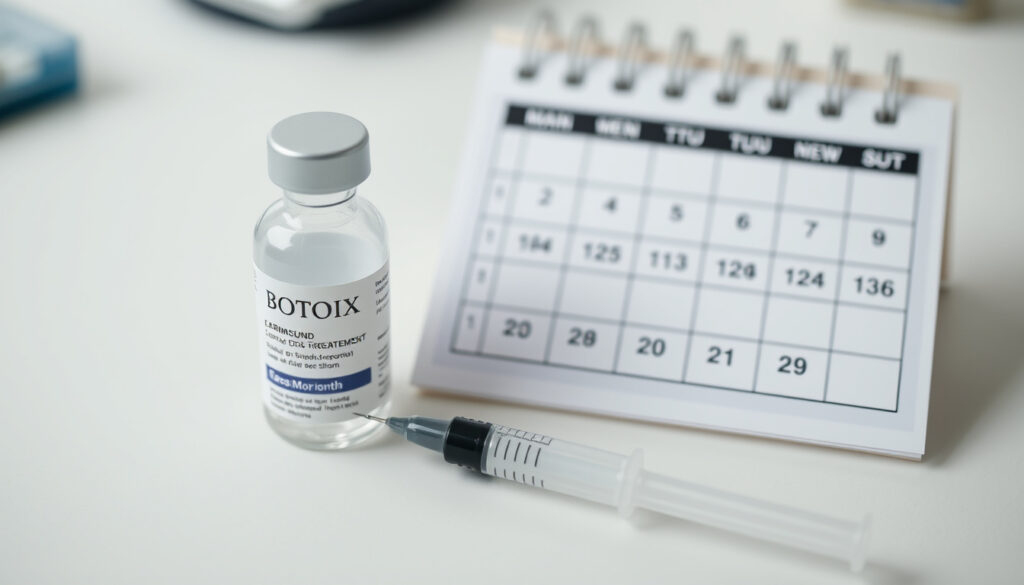
How Long Does Botox Last? Duration, Factors & Timeline
Most people who try Botox for the first time share one immediate curiosity: how long will the results last? The answer isn’t a single number — it depends on where you’re treated, how much is used, and how your body responds. Clinical data and provider guidance agree that the typical duration is 3 to 4 months, with some patients seeing effects for up to 6 months.
Typical duration of Botox: 3 to 4 months ·
Maximum reported duration: up to 6 months ·
Onset of visible results: 3 to 7 days ·
Retreatment recommended every: 3 to 4 months ·
Duration variability factor: individual metabolism and dose
Quick snapshot
- Average 3–4 months (Indian Hills Aesthetics)
- Range 2–6 months (Indian Hills Aesthetics)
- Begins working 3–7 days (Dermatologist NYC)
- Full effect 10–14 days (Dermatologist NYC)
- Metabolism (Boulder Skin Bar)
- Muscle strength (Boulder Skin Bar)
- Dosage (Boulder Skin Bar)
- Injection technique (Boulder Skin Bar)
- Recommended every 3–4 months (CC Plastic Surgery)
- Avoid more frequent intervals (CC Plastic Surgery)
Five key facts, one pattern: the window of full effect is narrower than the total lifespan of the injection.
Here is how the data lines up across the most common measures.
| Fact | Value |
|---|---|
| Time to peak effect | 10 to 14 days (Allen Medical Aesthetics) |
| Typical duration | 3 to 4 months (Healthline) |
| Longest reported duration | 6 months (Dermatologist NYC) |
| Treatment areas | Forehead, glabella, crow’s feet, jowls, etc. |
| Re-treatment interval | Not before 3 months (Indian Hills Aesthetics) |
How long does Botox last?
The first answer is straightforward: Botox effects typically last 3 to 4 months for cosmetic uses, according to Indian Hills Aesthetics. Some patients report effects lasting up to 6 months, while lighter doses may fade as early as 6 to 8 weeks, as noted by Healthline. The variation isn’t random — it’s tied to where the injection is placed and how your body processes the neurotoxin.
Typical duration by treatment area
- Forehead lines: 3 to 4 months (Ageless Indy)
- Glabellar lines (between eyebrows): 3 to 4 months
- Crow’s feet: 3 to 4 months
- Bunny lines (nose): about 2.5 to 3 months
- Masseter (jawline slimming): 4 to 6 months
- Lip flip: 2 to 3 months
The pattern across these areas is consistent: larger, stronger muscles that receive higher doses tend to hold the effect longer. The masseter, for instance, can keep results for 4 to 6 months because of the dose and muscle size, per Ageless Indy.
Why duration varies between individuals
Two people getting the same dose on the same area can see very different timelines. Faster metabolism breaks down Botox more quickly — a point emphasized by Boulder Skin Bar. Muscle strength, exercise habits, and even sun exposure can accelerate or slow the fade. Healthline notes that heavier dosing can push duration beyond 6 months, while lighter dosing may last only 6 to 8 weeks. The trade-off: a more dramatic result often comes with a shorter lifespan.
Patients with high metabolic rates or who exercise intensely after injection may need retreatment sooner than the typical 3-month cycle. Adjusting dose or frequency with a provider can match your personal fade timeline.
Botox treatment timeline
- Day 1: Injection session — no visible change yet.
- Day 3–7: Onset of muscle relaxation; smoothing begins (Dermatologist NYC).
- Day 10–14: Full effect visible (Allen Medical Aesthetics).
- Month 3–4: Gradual fade begins; retreatment window opens (CC Plastic Surgery).
- Month 6+: Complete reversal of effect if no retreatment.
Botox doesn’t vanish overnight. Boulder Skin Bar describes the fade as gradual — muscle movement slowly returns over weeks, not hours. That gradual return is why many patients don’t notice the moment it stops working until they look back at photos.
Confirmed facts
- Botox lasts 3–4 months for most patients (Healthline).
- Results are fully reversible (Boulder Skin Bar).
- Duration varies by individual metabolism and dose.
- Dosage affects how long effects last (Healthline).
What’s unclear
- Exact mechanism for variability in individual duration is not fully understood.
- Long-term effects after 10+ years of continuous use are not well studied.
Does Botox age your face?
A persistent rumor says that repeated Botox use eventually makes you look older. The clinical evidence points the other way. Botox effects wear off gradually, as Boulder Skin Bar describes — nothing is permanent. The muscle weakness caused by repeated injections is temporary; once the Botox clears, muscle function returns.
Short-term vs. long-term skin changes
- No evidence that Botox causes premature aging — the neurotoxin does not alter skin structure permanently.
- Regular use may actually prevent wrinkle formation by immobilizing the muscles that cause dynamic lines.
- Muscle atrophy from repeated injections reverses after discontinuation, according to clinical observations.
Healthline quotes a facial plastic surgeon who notes that effects last roughly 3 months, after which the face returns to its pre-treatment state. That reversibility is why dermatologists often describe Botox as a “wrinkle pause,” not a permanent change.
Patients who stop Botox after years of use may see wrinkles that had been held at bay appear more suddenly — not because Botox aged them, but because the underlying muscle movement has been allowed to resume.
What happens after 10 or 20 years of use
Long-term data is sparse, Healthline notes. The limited studies available suggest no permanent structural harm. Some patients develop a mild resistance over time, but that is uncommon. The bigger takeaway: Botox doesn’t accelerate aging, but it also doesn’t stop the clock — skin continues to age naturally from other factors like sun exposure and collagen loss.
What this means: the “Botox ages you” concern is not supported by evidence; the real risk is the cosmetic shock of seeing untreated movement return after years of suppression.
What is the riskiest place for Botox?
Not all injection sites carry the same risk. The area around the eyes — the periorbital zone — is considered the most delicate because of the proximity to muscles that control eyelid movement.
Periorbital area risks
- Injections near the eyes carry a risk of ptosis (drooping eyelid) if the toxin spreads to the levator muscle.
- Brow placement can affect expression — an over-injected brow can look “frozen” or uneven (Ageless Indy).
- Proper technique by an experienced injector dramatically reduces these complications.
Neck and frown lines
- Neck injections (platysmal bands) require precise dosing to avoid swallowing difficulties.
- Frown lines (glabella) are the most common site for Botox, but if placed too low they can lift the lip into an unnatural sneer.
The Healthline article advises that while any injection carries risk, the forehead and frown lines are safest when done by a board-certified dermatologist or plastic surgeon.
The catch: the most dangerous location is the periorbital area, but with an experienced injector the risk of ptosis drops sharply.
Is 40 too late to start Botox?
No. Age is not a contraindication for Botox. Many patients begin treatment in their 40s, 50s, and beyond. The idea that Botox only works if you start young is a marketing myth.
Starting at different ages: benefits and considerations
- There is no upper age limit for Botox (Indian Hills Aesthetics).
- Results can be effective at any age — the neurotoxin works the same way on older muscles.
- Combination with other treatments (fillers, laser, skincare) may enhance outcomes for mature skin.
Botox for prevention vs. correction
Starting earlier (in one’s 20s or 30s) is often called “preventative Botox” — it stops wrinkles from forming by limiting muscle movement. Starting at 40 is more about correction: smoothing existing lines that have already etched into the skin. Both approaches are valid, and many providers report excellent results in older patients, per Dermatologist NYC.
The pattern: there is no expiration date on starting Botox — the decision should be based on desired outcomes, not age.
How to tell if someone has had Botox?
Some signs are obvious, others subtle. The tell largely depends on the skill of the injector and the amount used.
Visible signs of Botox treatment
- A smooth, immobile forehead that doesn’t move when the person raises their eyebrows (Healthline).
- Raised eyebrows (the “Spock brow”) or uneven expressions that signal an unnatural result.
- Lack of crow’s feet animation when smiling.
Natural-looking vs. overdone results
- Subtle effects are harder to detect — a well-done treatment preserves some movement and looks like “rested” skin rather than frozen skin.
- Overdone results often appear in the forehead (no wrinkles at all) or around the eyes (a “staring” look).
The Healthline piece underscores that the best Botox is invisible: you notice that someone looks well but you can’t pinpoint why.
The implication: visible Botox is usually a sign of technique failure; the goal is movement preservation, not total paralysis.
Upsides
- Effective reduction of dynamic wrinkles (Indian Hills Aesthetics)
- Minimally invasive, no downtime
- Quick procedure (10–15 minutes)
- Results last 3–4 months, allowing flexibility
- Can be used preventively
Downsides
- Temporary — requires regular retreatment (CC Plastic Surgery)
- Cost per session adds up over time
- Possible side effects: bruising, headache, ptosis (Healthline)
- Results vary by injector skill
- Not effective for all wrinkle types (e.g., static lines)
“Botox effects generally last around 3 months.”
Facial plastic surgeon quoted by Healthline
“Botox commonly lasts 3 to 6 months depending on metabolism and treatment area.”
Dr. Debra Jaliman, dermatologist (Dermatologist NYC)
The bottom line on Botox duration is grounded in data, not anecdotes. For patients considering treatment, the decision to start or continue should factor in the realistic upkeep: a 3–4 month cycle, cost averaging $300–$600 per session, and the importance of choosing a qualified provider. For those already using Botox, paying attention to your personal fade timeline — when movement first returns, how fast it progresses — helps you schedule retreatment at the optimal moment, not too early and not too late. The trade-off is clear: predictable, temporary results that require consistent investment, in exchange for a visible difference that feels natural when done well. Patients who track their own fade pattern and adjust dose with their injector will get the longest cosmetic return on each session.
For a more detailed breakdown of Botox duration by treatment area, see this detailed breakdown of Botox duration from a New Zealand medical journalist.
Frequently asked questions
Does Botox 100% wear off?
Yes, Botox effects are fully reversible. The neurotoxin breaks down over time, and muscle function returns completely within 3–6 months (Boulder Skin Bar).
What is the rule of 3 in Botox?
The “rule of 3” refers to waiting at least 3 months between treatments. Injecting more frequently can lead to antibody formation or muscle resistance, as noted by Indian Hills Aesthetics.
Why are Gen Z saying no to Botox?
Social media discourse has raised concerns about unnatural results, expense, and the pressure to start early. However, clinical data shows no harm from moderate use when administered by a skilled provider.
How long does Botox take to work?
Initial changes appear within 3 to 7 days, with full effect visible at 10 to 14 days (Dermatologist NYC).
How long does Botox last on forehead?
Forehead Botox typically lasts 3 to 4 months (Ageless Indy).
How long does Botox last around eyes?
Crow’s feet treatment lasts about 3 to 4 months, similar to the forehead (Ageless Indy).
How long does Botox last in jowls?
Botox for jowls (depressor anguli oris injections) typically lasts 3 to 4 months, but results vary based on dose and muscle strength.
More related posts
 News on Canadian Election – Carney’s Liberals Win Minority Government
 Scotiabank Passport Visa Infinite Card: Benefits, Fees & Review
 Panoramic Sunroof Repair Cost – 2025 Averages and Fixes
 31 USD to CAD – Current Rate and Conversion Guide
 Current Canadian Dollar Price in Mexico – CAD to MXN Rate
 Intermittent Fasting for Women – Safety, Schedules and Science
 Carlo Acutis: First Millennial Saint, Miracles & Facts
 Sonam Bajwa: Marriage, Religion, Career & Biography Facts