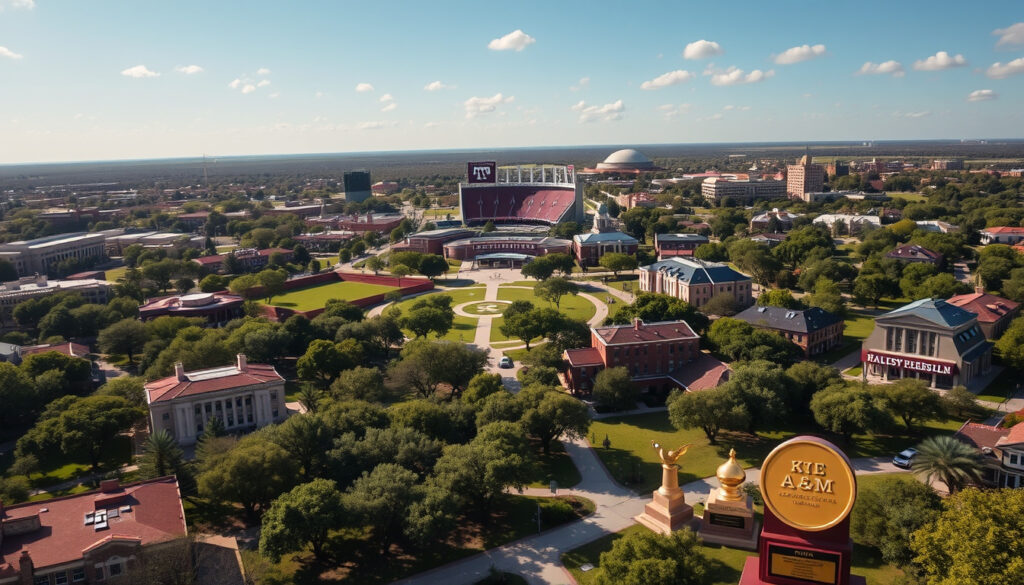
Texas A&M – 2025 Rankings Admissions and Key Facts
Texas A&M University stands as one of the most prominent public research institutions in the United States, serving more than 81,000 students across a campus founded on principles of agricultural and mechanical education. The university’s research enterprise generates more than $1.4 billion in annual expenditures, positioning it among the largest in the nation and earning membership in the Association of American Universities, a designation reserved for institutions with the highest levels of research activity.
Ranked No. 21 among all public universities in the 2025-26 U.S. News & World Report rankings, Texas A&M has established itself as a national leader in engineering and business programs while maintaining top-tier status in agricultural sciences. The university employs more than 4,300 faculty members committed to instruction and research across more than 130 undergraduate degree programs.
What is Texas A&M University?
Texas A&M University is a comprehensive public research university located in College Station, Texas. Founded in 1876 as the Agricultural and Mechanical College of Texas, the institution was created under the Morrill Act to provide education in agriculture, mechanics, and military tactics. Today, the university operates as the flagship campus of the Texas A&M University System, which includes multiple branches throughout the state.
Location, Campus, and Institutional Identity
The main campus spans approximately 5,200 acres in College Station, Texas, a city that has grown substantially around the university since its founding. The institution takes its name from the state’s abbreviation “T” and the letters “A&M,” which stand for Agricultural and Mechanical. Reveille, a Rough Collie, serves as the university’s official mascot and holds the distinguished rank of “First Lady of Texas A&M.”
Kyle Field, the university’s main athletic facility, serves as home to the Aggies football program and represents one of the largest stadiums in collegiate athletics. The campus maintains extensive facilities for research, instruction, and student life, including the recently expanded Annenberg Presidential Conference Center and the Memorial Student Center.
The term “Aggies” has become synonymous with Texas A&M students, alumni, and fans. This nickname derives from the agricultural roots of the institution and reflects a tradition that unites hundreds of thousands of former students worldwide.
Texas A&M at a Glance
| Category | Detail |
|---|---|
| Founded | 1876 |
| Location | College Station, Texas |
| Enrollment | Over 81,000 students |
| Mascot | Reveille (Rough Collie) |
| Research Expenditures | More than $1.4 billion annually |
| Faculty Members | More than 4,300 |
| Athletic Conference | Southeastern Conference (SEC) |
| Main Athletic Facility | Kyle Field |
Key Facts About Texas A&M
- Ranks No. 21 among all public universities (U.S. News & World Report, 2025-26)
- No. 1 public university in Texas (Wall Street Journal, 2026)
- Top 10 rankings in both engineering and business programs nationally
- Member of the Association of American Universities (AAU)
- Ranks No. 5 nationally in science and engineering PhDs awarded
- Over $1.4 billion in annual research expenditures
- Over 81,000 students enrolled as of fall 2025
What is Texas A&M Known For?
Texas A&M University has built a reputation for academic excellence across multiple disciplines, with particularly strong performance in STEM fields and professional programs. The university’s commitment to research, teaching, and service has earned it recognition as one of the nation’s premier public institutions.
Ranking Performance Across Major Systems
In the Wall Street Journal’s 2026 Best Colleges rankings, Texas A&M achieved the top position among all Texas institutions and placed 12th among public universities nationally. The U.S. News & World Report 2025-26 rankings positioned the university at No. 21 among public institutions and No. 13 for Best Value among public universities, recognizing both academic quality and affordability.
Washington Monthly’s “America’s Best Colleges for Research” rankings placed Texas A&M at No. 16 nationally and No. 8 among public universities, reflecting the institution’s substantial contribution to American research enterprise. On the global stage, the university holds position #144 in the QS World University Rankings 2026, while Niche’s 2026 rankings positioned Texas A&M at 59th among the best colleges in America and 3rd in Texas.
Texas A&M also achieved the highest-ranked position in the Southeastern Conference (SEC) for research according to Washington Monthly, underscoring the institution’s prominence even among elite peer institutions in the nation’s premier athletic conference.
With more than $1.4 billion in annual research expenditures, Texas A&M ranks among the largest research universities in the United States. The institution’s AAU membership places it among the 71 North American universities with the highest research activity levels.
Academic Programs and Strengths
Texas A&M holds Top 10 national rankings in both engineering and business programs, according to the Wall Street Journal. The university’s engineering college ranks No. 25 in America according to Niche, while its agricultural sciences program stands at No. 2 among the best colleges for agricultural sciences nationally. The institution ranked No. 5 in the nation in the number of science and engineering PhDs awarded, demonstrating depth at the graduate and professional levels.
Beyond STEM fields, Texas A&M offers comprehensive programs in business, liberal arts, education, and veterinary medicine. The Mays Business School and the College of Engineering serve as anchor colleges for professional education, while the College of Agriculture and Life Sciences maintains the institution’s founding mission in agricultural education.
Student Experience and Campus Life
The university ranked No. 1 in Texas for first-year experience and study abroad opportunities, according to the Wall Street Journal’s 2026 rankings. The U.S. News rankings specifically recognized Texas A&M as No. 1 in Texas and No. 3 among public institutions nationally for Study Abroad programming, reflecting robust support for international educational experiences.
The university also received recognition for its commitment to student political tolerance and resisting politicization, according to U.S. News rankings. This distinction speaks to the campus environment’s focus on balanced discourse and academic freedom across the political spectrum.
Texas A&M Acceptance Rate and Admissions
Prospective students and families frequently seek current admissions data when evaluating Texas A&M as a college option. The institution’s size and reputation make it one of the most competitive public universities in the South, though precise acceptance rate figures for the most recent application cycle are not available in the current data set.
Admissions decisions at Texas A&M typically consider multiple factors beyond academic performance alone. The university’s holistic approach evaluates coursework rigor, extracurricular involvement, leadership experience, and personal circumstances alongside grade point averages and standardized test scores.
Understanding Costs and Financial Value
As a public institution, Texas A&M offers different tuition structures for in-state and out-of-state students. For Texas residents, in-state tuition and mandatory fees total approximately $13,000 annually before accounting for room, board, and personal expenses. Out-of-state students can expect tuition and fees approaching $40,000 annually under the standard cost structure.
The university earned recognition as No. 13 for Best Value among public institutions nationally, according to U.S. News & World Report. This ranking reflects both the cost of attendance and the measured outcomes for graduates, including retention rates, graduation rates, and post-graduation success metrics. Students interested in financial aid should consult the official Texas A&M financial aid office for detailed information about scholarships, grants, and work-study programs.
Academic Programs and Major Selection
Texas A&M offers more than 130 undergraduate degree programs across 16 colleges and schools. Students applying for admission select a primary major during the application process, though many first-year students enter through the College of Liberal Arts undeclared pathway before selecting a specific academic concentration.
The most popular majors include engineering disciplines, business administration, agricultural sciences, biological sciences, and biomedical sciences. Competitive entry into programs like engineering and business often requires students to complete foundational coursework before full admission to the upper-division program.
Precise acceptance rate figures for the 2025 application cycle are not available in the current data set. Students should consult the official Texas A&M admissions website for the most current application requirements, deadlines, and selectivity statistics.
Texas A&M Football and Aggie Traditions
Football occupies a central place in Texas A&M’s culture, drawing hundreds of thousands of fans to Kyle Field each season. The Aggies compete in the Southeastern Conference (SEC), having joined the league in 2012, and have built a competitive program that consistently challenges for conference championships.
Athletic Facilities and traditions
Kyle Field serves as the home of Aggies football and represents one of college athletics’ most storied venues. The stadium’s capacity and gameday atmosphere create an environment that regularly ranks among the nation’s best collegiate football experiences. The tradition of the 12th Man, which calls on all students to be prepared to enter the game if needed, represents one of the most distinctive aspects of Texas A&M football culture.
The SEC provides Texas A&M with conference competition against other nationally prominent programs, including Alabama, Georgia, LSU, and Ole Miss. This alignment has elevated the university’s athletic profile while increasing exposure to some of the nation’s top collegiate sports programs.
Beyond Football: Olympic Sports and Recreation
While football generates the most attention, Texas A&M maintains competitive programs across the NCAA Division I landscape. Olympic sports including track and field, swimming and diving, cross country, and tennis have produced conference championships and individual accolades. The university’s recreation facilities serve the broader student body, with comprehensive intramural and club sport offerings.
Founding Traditions and Institutional Identity
Texas A&M traces its roots to 1876, when the Texas Legislature established the Agricultural and Mechanical College of Texas as the first public institution of higher learning in the state. The original mission combined practical education in agriculture and mechanical arts with military-style discipline, creating a distinctive character that persists in modified form today.
The military component has evolved from mandatory military training for all male students to the Corps of Cadets, a voluntary program that remains one of the nation’s largest uniformed student organizations. This heritage contributes to campus traditions including the Bonfire memorial, Muster, and Silver Taps, which hold deep meaning for alumni.
Historical Timeline
Texas A&M University has evolved across more than 140 years from a small agricultural college to one of the nation’s largest research universities.
- 1876: The Agricultural and Mechanical College of Texas opens its doors as the first public institution of higher learning in Texas.
- 1912: The institution becomes part of the Texas A&M University System as the flagship campus.
- 1948: Graduate programs expand significantly, laying groundwork for research university status.
- 1989: Texas A&M joins the Southwest Conference, establishing athletic prominence in the region.
- 2012: The university moves to the Southeastern Conference, elevating its national athletic profile.
- 2024: Enrollment reaches record levels, surpassing 81,000 students.
Established and Uncertain Information
Transparency about what is confirmed and what remains uncertain helps readers evaluate the information presented.
| Established Information | Information Requiring Additional Sources |
|---|---|
| Enrollment exceeds 81,000 students as of fall 2025 | Precise 2025 acceptance rate figures |
| Research expenditures exceed $1.4 billion annually | Specific tuition rates for the 2025-26 academic year |
| Rankings from U.S. News, Wall Street Journal, Washington Monthly, QS, and Niche | Detailed Aggie traditions and their historical origins |
| Association of American Universities membership | Specific acceptance criteria for each college within the university |
| Top 10 rankings in engineering and business nationally | Future expansion or strategic plan details |
| SEC conference affiliation since 2012 | 2025 football schedule and game outcomes |
Texas A&M’s Role in Texas Higher Education
As the state’s flagship public research university, Texas A&M serves as an economic engine and intellectual hub for Texas. The institution’s research enterprise generates substantial economic activity while producing graduates who contribute to industries across the state and nation. The Texas A&M University System, with an estimated annual economic impact exceeding $4.9 billion, ranks among the state’s largest employers and most significant institutional drivers.
The university’s land-grant heritage continues to inform its mission, with programs in agriculture, natural resources, and rural development serving Texas communities. Extension services and research stations operate throughout the state, translating academic discoveries into practical applications for agricultural producers and families.
Sources and Rankings Data
“Texas A&M is ranked No. 21 among all public universities and No. 13 for Best Value among public institutions in the 2025-26 U.S. News & World Report rankings.”
— Texas A&M University Stories, September 2025
Rankings data for this article comes from multiple sources, including the Texas A&M University Stories office, which compiles official university recognition from major publications. The Niche rankings provide user-generated assessment data, while the QS World University Rankings offer global context.
The SEC Sports website provides official conference information for the university’s athletic programs. Research enterprise data originates from the Washington Monthly research rankings, which assess institutional contribution to American research.
Summary
Texas A&M University represents one of America’s most significant public research institutions, with an enrollment exceeding 81,000 students, more than $1.4 billion in annual research expenditures, and national rankings that place it among the top tier of American universities. The institution holds Top 10 positions in engineering and business programs, ranks No. 2 nationally in agricultural sciences, and maintains membership in the prestigious Association of American Universities. Located in College Station, Texas, the university serves as the flagship campus of the Texas A&M System and a central institution in the state’s higher education landscape. Prospective students seeking to understand the full range of academic programs and admissions options should consult the official Texas A&M website for current information.
Frequently Asked Questions
Is Texas A&M a good school?
Texas A&M ranks among the nation’s best universities, with No. 21 positioning among public institutions (U.S. News, 2025-26) and Top 10 rankings in engineering and business. Research expenditures exceeding $1.4 billion annually and AAU membership confirm the institution’s standing as a major research university.
What does A&M stand for?
A&M stands for Agricultural and Mechanical, reflecting the institution’s original founding mission established in 1876. The name has persisted through the university’s evolution from a small agricultural college to a comprehensive research university.
How to get into Texas A&M?
Texas A&M evaluates applicants based on academic performance, coursework rigor, standardized test scores, extracurricular involvement, and personal circumstances. Detailed admissions criteria and application deadlines are available through the official admissions website.
Where is Texas A&M located?
Texas A&M University is located in College Station, Texas, approximately 100 miles northwest of Houston. The campus sits on approximately 5,200 acres and serves as the anchor institution for the Bryan-College Station metropolitan area.
What is Texas A&M known for?
Texas A&M is known for top-ranked engineering, business, and agricultural sciences programs; a robust research enterprise exceeding $1.4 billion annually; distinctive traditions including the 12th Man and Corps of Cadets; and competitive SEC athletics. The institution serves as the flagship campus of the Texas A&M University System.
What majors does Texas A&M offer?
Texas A&M offers more than 130 undergraduate degree programs across 16 colleges and schools. Popular programs include engineering disciplines, business administration, agricultural sciences, biological sciences, and biomedical sciences.
How much is tuition at Texas A&M?
Tuition varies significantly between in-state and out-of-state status. For the most current tuition rates and information about scholarships and financial aid, students should consult the official financial aid office or admissions website.
More related posts
 Pink Salt Trick for Weight Loss: Does It Really Work?
 Work Permit Processing Time Canada – Current IRCC Times 2025
 Intermittent Fasting for Women – Safety, Schedules and Science
 Dominican Republic Nightclub Roof Collapse: Jet Set Facts
 Magalie Lépine-Blondeau Conjoint – Verified Facts and Updates
 Eid ul Adha 2026: Date, Arafat Day & Global Details
 Planet Hollywood Costa Rica – Open and Operating in 2025
 Map of New Brunswick – Detailed Guide to Cities, Roads, Counties